
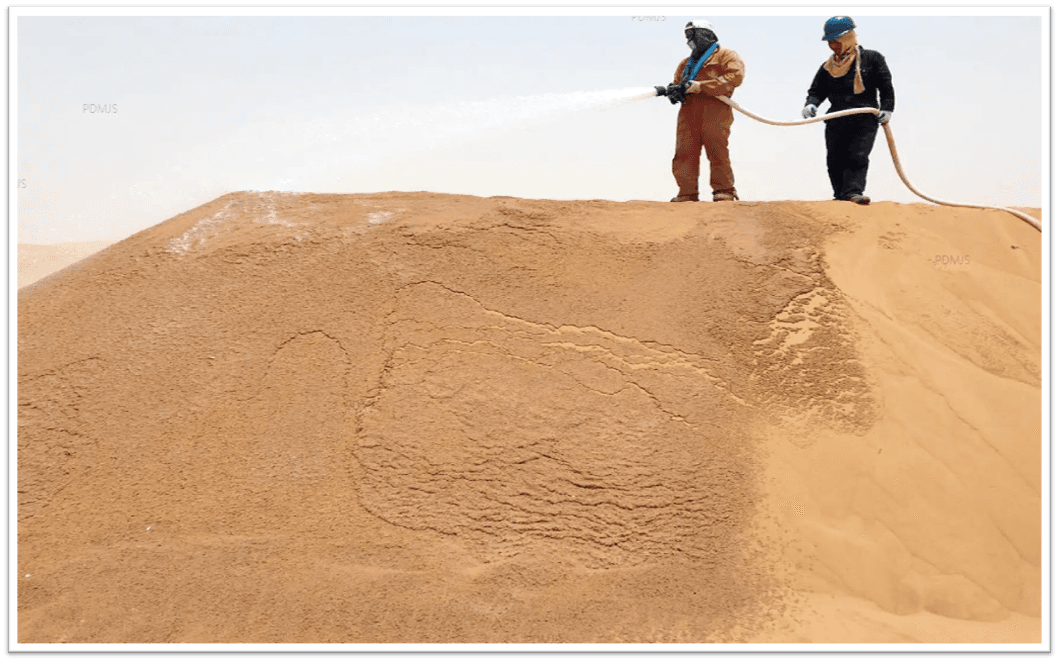
A large share of Saudi agricultural land sits on calcareous sand — sandy soils with high free calcium carbonate content. These soils combine the hydraulic challenges of classical sand (rapid drainage, low nutrient retention) with a chemistry that limits micronutrient availability. They are also the soils most commonly encountered in date palm, vegetable, and fodder operations across the Kingdom.
Why standard amendments struggle here
Gypsum, biochar, and polymer hydrogels each address fragments of the problem, but calcareous chemistry neutralizes many of their benefits. Gypsum loses much of its structural effect within 1–2 years. Polymer hydrogels, aside from environmental concerns, degrade faster under the thermal cycling we see in KSA. Biochar gives carbon benefits but does little for the sand-water interface problem.
What LNC does differently
LNC operates at the molecular interface of sand and water. On calcareous sand, its nanoclay particles coat grains without chemically reacting with the calcium carbonate matrix — so the soil's mineral chemistry is preserved while hydraulic behavior is transformed.
- Water retention improvement: +40 to +55% on coarse calcareous sand
- Duration: 4 to 5 years under Saudi climatic cycles
- Compatibility: drip, pivot, and flood irrigation all validated
- No soil compaction, no pH shift, no change to calcium availability
Field program with Estidamah
Our ongoing research program with the National Research & Development Center for Sustainable Agriculture (Estidamah) instruments representative calcareous plots across several crop systems and benchmarks LNC against no-amendment controls through full growing seasons. Initial readings align with published international results.
What it means for Saudi operators
For Saudi farm operators, the takeaway is that calcareous chemistry does not preclude LNC adoption — it is one of the soil types where LNC's mechanism has the most room to deliver. For procurement officers, it means claims on LNC performance abroad translate to the Kingdom's specific conditions with appropriate formulation adjustments, rather than requiring a wholesale rethink.